Business Process Automation

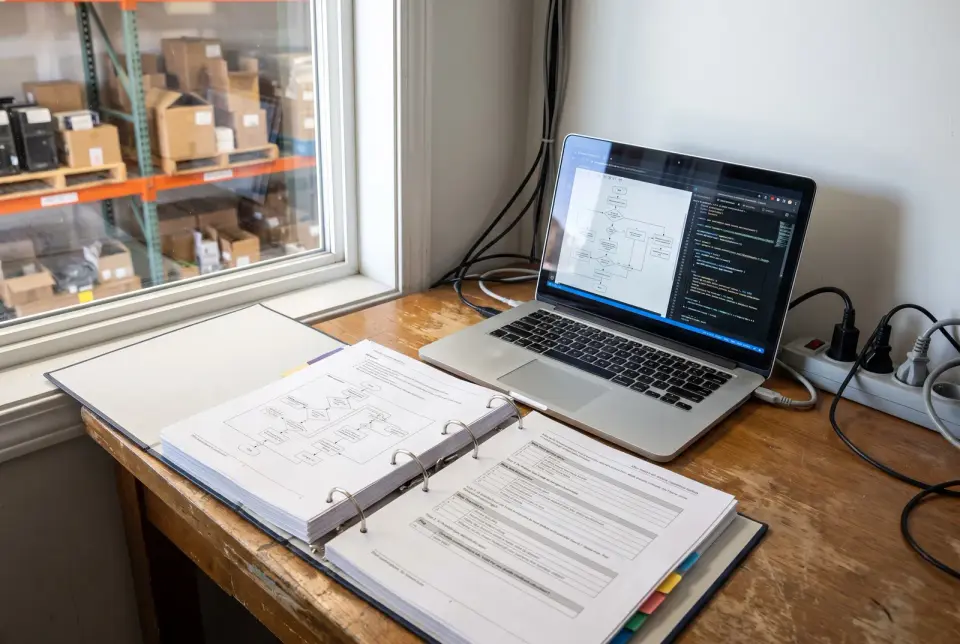
Every business runs on manual steps nobody questions anymore: copying between systems, forwarding emails, retyping the same data, chasing people for updates. We find those steps, put a price on the hours they eat in a year, and automate the ones where the numbers are embarrassing. The rest we leave alone, because the payback isn't there.

From€500per project

  • €0a month in licences, the code is yours
  • 100%of transfers written to a log
  • 1 processto start with, the one that hurts most
  • 1 dry runbefore the manual transfer is switched off

Process automation connects the tools you already use so data doesn't have to be retyped by a person. A task that takes 30 minutes a day costs about 130 hours a year. If we can automate it for less than those hours cost you, it pays off. A single-task automation costs from €500, a full business process from €800.

We build on n8n, Make or custom code, depending on what your team can maintain without us.

We build on n8n, Make or custom code, depending on what your team can maintain without us.

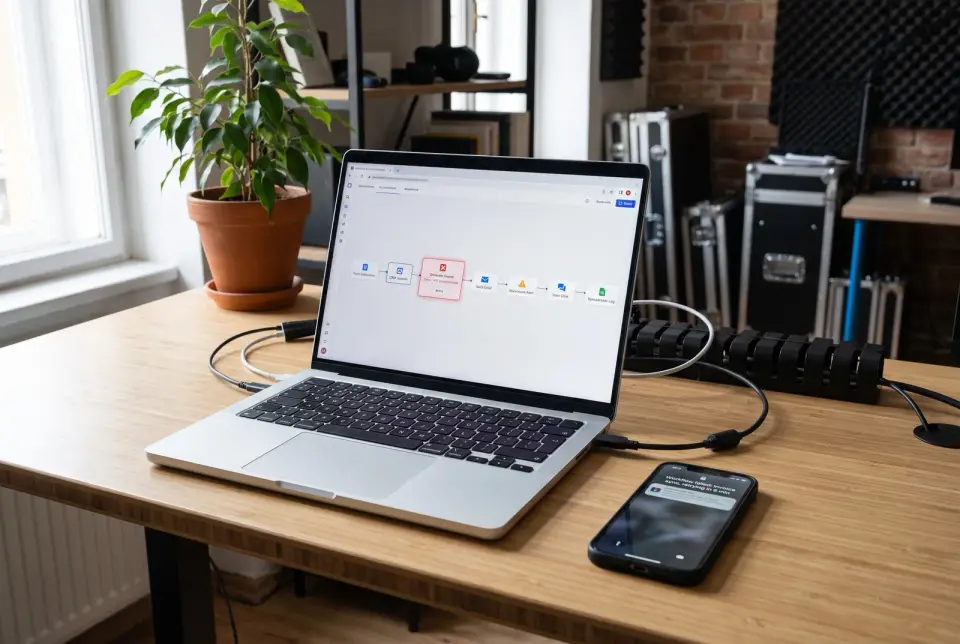
Every automation has a log and alerts, so you hear about an error before a customer does.

Every automation has a log and alerts, so you hear about an error before a customer does.

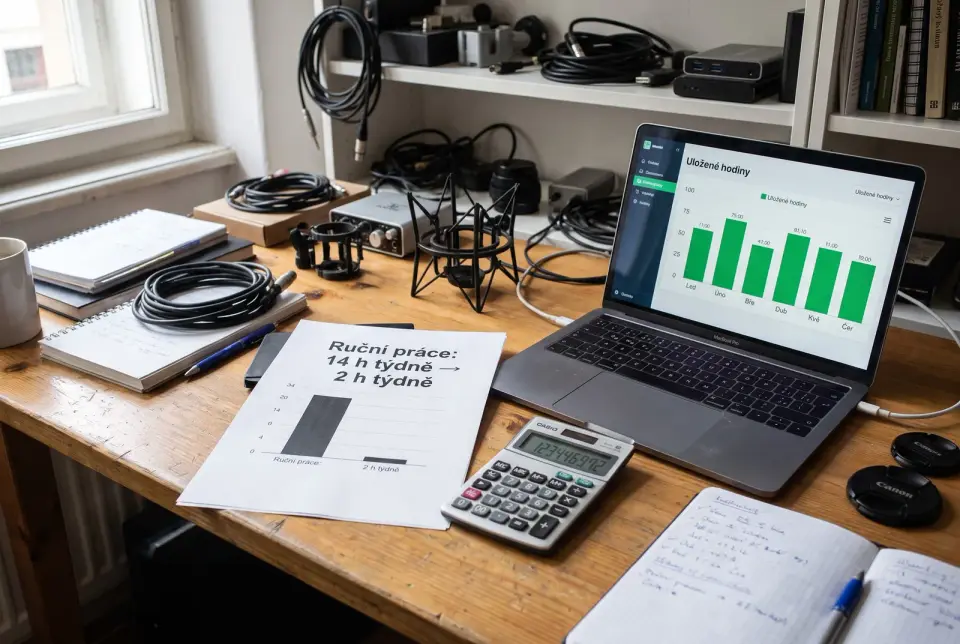
We calculate the savings before building and measure them after launch, in hours and money.

We calculate the savings before building and measure them after launch, in hours and money.

You get documentation, so the automation can be changed without us.

You get documentation, so the automation can be changed without us.

Every service in this category, explained

  • Workflow

    Processes connected across the tools you already use.

    In short As a business process automation agency, we wire multi-step processes together across your tools: when X happens, Y runs and Z gets notified. We build it on n8n, Make or custom code, whichever your team can actually keep running once we're gone.

    How we workWe start by mapping the process as it actually runs day to day, since that rarely matches what the manual describes. Then we choose the tool based on what your team can realistically maintain once we're gone. We handle error states too: what happens when a service goes down, and how you'll know a step didn't run.

    What you getA live automation connecting the tools you already use, with an alert whenever a step fails. We hand it over with full documentation, running on your own account, so you're never locked into us.

    What's included

    • We map how the process actually runs
    • n8n, Make or custom code
    • Errors caught and flagged
    • Docs and accounts stay yours

    Business processes

    Approvals and document flows that run without reminders.

    In short Approvals, onboarding, document flows and handovers are what a business process automation agency handles first: we map them honestly, and the map alone usually tells you something. Then we automate the steps that don't need judgment and keep a person in the ones that do.

    How we workWe map who requests what, where it gets retyped, and where it just sits waiting. Then we split the steps into ones that need human judgment and ones that don't, and automate only the second group. We add deadline tracking and cover for absences, so the whole process doesn't depend on one person being at their desk.

    What you getA process map on a single page, plus a live approval flow, document routing or onboarding process, complete with deadlines, alerts and cover for absences. You also get a status overview, so nobody has to send an email asking where things stand.

    What's included

    • The whole process on one page
    • No automation where judgment matters
    • Deadlines with alerts when things slip
    • Fewer "is this stuck?" emails

    CRM

    A CRM that fills itself.

    In short Leads get logged, deals get updated, follow-ups get scheduled, all on their own. Your sales team spends its time selling instead of doing data entry, and the pipeline finally shows what's actually happening.

    How we workWe set your deal stages to match how you actually sell instead of the tool's default template. We connect your lead sources, web, email and phone, so every lead lands in the system with its origin attached, and add automatic follow-up tasks. We also connect your calendar, quotes and invoicing, so the same data never gets typed in three times.

    What you getA CRM filled with real data, stages that match how you actually sell, automatic tasks and a visible source for every lead. If you haven't picked a CRM yet, you also get a comparison of options, including per-user pricing and where the cost climbs as your team grows.

    What's included

    • Leads land in your CRM automatically
    • Know exactly where each deal came from
    • Pipeline stages that match how you sell
    • We'll help you choose the system too

    Marketing

    Marketing that runs to plan even in a busy week.

    In short Campaign flows, lead scoring, segment syncing and reports, all running on schedule, so marketing keeps working every day even when the marketing person is on holiday.

    How we workWe set up automated campaigns, behavior-based segmentation and contact handoff between tools, with a rule that stops one person getting three different messages on the same day. We sync data between your store, email tool, ad accounts and CRM. Consent and opt-outs are handled properly, since a fine costs a lot more than the whole automation.

    What you getA running marketing automation with segmentation, synced audiences and frequency capping, plus reports that build themselves. It comes with a map showing exactly what data flows where, handy the next time a consent check comes up.

    What's included

    • Segments built from behavior
    • Store, email and CRM stay in sync
    • Consent and opt-outs handled properly
    • Reports show up on their own

    Task

    File sorting, data transfers and documents without manual work.

    In short The small things nobody minds until they add up: renaming and sorting files, moving data between sheets, generating documents, sending reminders in bulk. Individually none is worth solving; together they take an afternoon a week. Automation pays for itself fastest here.

    How we workWe start by measuring how much time these small tasks actually take. We pick the ones with the fastest payback and start there, because a quick win makes the strongest case for continuing. We keep the solution simple and readable, so your team can edit it later without needing us.

    What you getSmall tasks running on their own: renaming and sorting files, moving data between spreadsheets, generating documents, sending bulk reminders. You also get the time measured before and after, so you can see exactly what it saved.

    What's included

    • Fastest payback first
    • Simple enough to edit without us
    • Time saved is measured
    • You see results right away

    Reporting

    Reports that build themselves and arrive on Monday morning.

    In short Reports that put themselves together: data pulled from every system, formatted, delivered Monday at 8 a.m. Nobody spends Friday afternoon building spreadsheets again.

    How we workWe define every number once, and write that definition down. Then we pull data from every system, format it consistently and set up delivery. We handle source outages too, so a report never lands with a silent zero that someone mistakes for a drop in sales.

    What you getA report that builds itself and lands by email, in a shared file, or on the office screen, whenever you choose. You also get a written definition of every number, and an alert if a source fails to deliver.

    What's included

    • Reports build and send themselves
    • Every number defined in writing
    • Missing data handled cleanly
    • Easy to adjust, never rebuilt

    Sound familiar?

    John Doefirst call
    1. We retype orders from the shop into accounting by hand

    2. Every manual copy costs time and now and then ends in a typo on an invoice. Automation sends the order to accounting, the warehouse and the CRM the moment it's placed.

    3. We spend a whole day building a report from five spreadsheets

    4. Data can be pulled from your systems automatically and the report assembles itself every Monday morning. A person just reads it and decides.

    5. Leads get lost between email and the CRM

    6. Enquiries from the website, email and phone create themselves in the CRM, get assigned to a salesperson and trigger a reminder when nobody responds. None of them gets buried in someone's inbox.

    7. When a colleague is off sick, the process stops

    8. A procedure only one person knows is a risk. Automation turns it into steps that run the same way every time, and the documentation explains what happens where.

    Which one sounds like you?

    Pick your case and enter your own numbers. The screen works out what you're losing or gaining.

    I repeat the same task every day

    Minutes a day on the same task30 min
    How many people do this2
    How much your hour is worth€30

    The routine eats up

    22 hours a month

    30 min a day for 2 people over 22 working days is €660 a month at €30 an hour. Automation typically costs €1,200 and pays for itself in 1.8 months.

    22 working days in a month. Upper estimate: we assume automation takes over the task entirely. Typical price from the studio price list.

    My tools won’t talk to each other

    Records a week you move by hand between systems61
    Minutes per record3 min
    How much your hour is worth€30

    Manual data entry costs

    €396 a month

    61 records a week at 3 min each is 13.2 h a month at €30 an hour. An integration typically costs €1,150 and pays for itself in 2.9 months.

    We count a month as 4.33 weeks. We don't count mistakes made during entry, their cost comes on top. Typical price from the studio price list.

    I want AI that actually pulls its weight

    Questions from clients a month410
    Minutes per reply4 min
    How many of them repeat40%

    An AI assistant could take

    10.9 hours a month

    Of 410 questions, 164 repeat. At 4 min per reply that's 131 hours a year. An AI chatbot typically costs €1,650.

    Upper estimate: we assume the bot handles every repeat question, in practice some will still go to a person. Typical price from the studio price list.

    Set up Zapier yourself?

    Zapier, Make and n8n come with ready templates, and connecting two apps takes an afternoon. The difference shows in processes across several systems, in error handling and in who fixes it when something changes.

    When you can do it yourself

    • You're connecting two apps, like a form and a spreadsheet
    • There's a ready-made guide for the template
    • Nothing serious happens if it stalls now and then
    • You enjoy tinkering with tools and have the time

    When it starts costing money

    • The process spans the shop, accounting, warehouse and CRM at once
    • Errors aren't reported anywhere and you find out from a customer
    • The tool's per-operation pricing grows faster than the savings
    • Whoever built the automation left and nobody knows how it works

    From manual retyping to a process that runs itself

    1. You know how many hours are at stake

      Call and calculation

      We walk through the process step by step and work out what it costs today in hours and money. We do the maths free on the first call.

    2. Every step is on paper

      Process map

      We write down what triggers the process, where the data flows and where a person decides. You get a fixed price.

    3. The automation runs

      Build

      On n8n, Make or custom code, connected to the systems you already use. Test data first.

    4. The exceptions work too

      Live data test

      We run the automation alongside the manual process and compare results. We fix the exceptions the map missed.

    5. You hear about errors at once

      Error monitoring

      A log of every run and an alert by email or chat when something fails. Failed records aren't discarded and can be replayed.

    6. The team knows how it works

      Handover

      Documentation, a short training session and a savings check after the first month. Maintenance can stay with us or move to your team.

    What automation costs

    Single-task automation from €500, workflow, marketing and reporting from €600, CRM and business processes from €800. The tool subscription is paid directly. Nothing is added on top, the price is final.

    Check pricing

    Where we've done this before

    • 6image templates
    • 5content categories
    • 10ready captions in Czech
    • 4interface languages

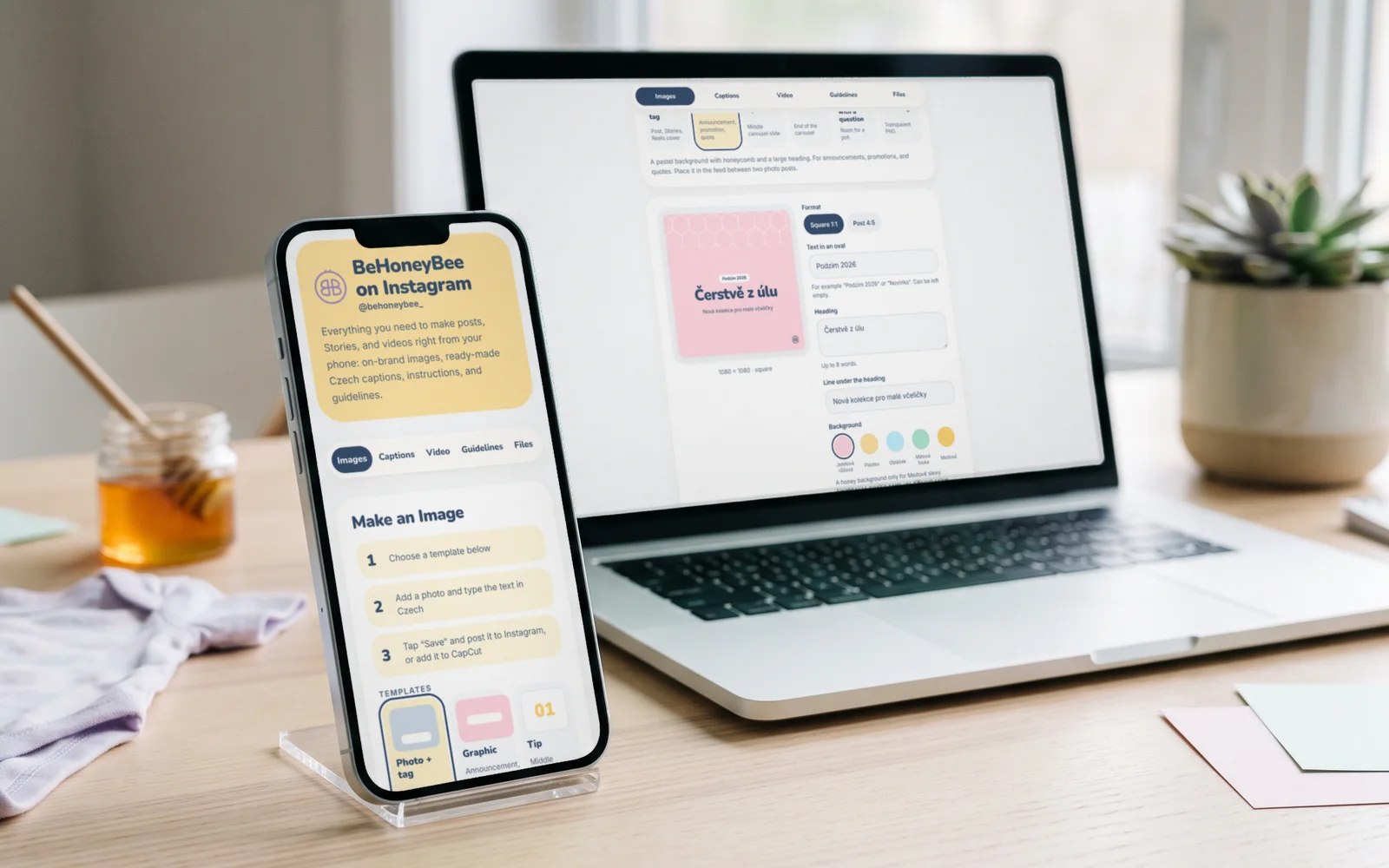
    A tool on the phone: an on-brand post, Story or Reels cover, with a ready-made Czech caption.

    Open the case study
    BeHoneyBee Instagram studio
    Children's fashion, social media · 2026

    BeHoneyBee Instagram studio

    AI built to actually do the work

    AI and automation earn their keep when they’re wired into real workflows with real data. Without that, it’s just theater. We build the first kind: we map how the work actually happens, put a price on the wasted hours, and automate the steps where the numbers make the case on their own. Tools run on infrastructure your team can maintain, monitored so failures get flagged immediately, and handed over with full documentation and access. You end up owning the code and the pipeline. There’s no black-box subscription you can’t see inside.

    What you ask most often

    What is business process automation?

    Business process automation replaces repetitive manual steps between systems: when one thing happens, a second is triggered and a third is notified. For example, a shop order records itself in accounting, the warehouse and the CRM.

    How much does automation cost?

    A simple task from €500, a workflow across several systems from €600, typically around €1,200, a full business process from €800. Plus the tool subscription if we use one. Nothing is added on top, the price is final.

    How do I know it pays off?

    We work it out together. A 30-minute daily task costs about 130 hours a year. Multiply that by the hourly cost of the person doing it and compare with the price of automation. It usually pays back within a year.

    What do you build automations on?

    On n8n, Make or custom code. n8n can run on your own server with no per-operation fees, Make is faster to start, custom code makes sense at high volumes. We pick what your team can maintain.

    What if the automation breaks?

    Every run is logged and an error triggers an alert. Records that didn't go through aren't discarded and can be replayed once the cause is fixed. Nothing disappears silently.

    Can you connect a system with no API?

    Usually, yes: through a regular export, the database, email messages or a bot that clicks like a person. That's more fragile than an API, so we monitor such connections more closely.

    Which processes get automated most often?

    Orders and invoicing, leads into the CRM, customer onboarding, regular reports and behaviour-based marketing emails. They all have clear rules and lots of repetition.

    How long does the build take?

    A simple automation takes a few days, a process across several systems two to four weeks, including a test alongside the manual process.

    Can we change the automation ourselves later?

    Yes. We hand over documentation and briefly train the person who'll manage it. In n8n and Make most changes need no programming.

    Ready to build something solid?

    Drop us a message. We reply within a few hours to set up a quick chat.

    1. 1Within hours: a human reply: first thoughts, maybe a question or two.
    2. 2Within days: a 30-minute call. You talk, we listen. Free, no obligations.
    3. 3After the call: a written fixed quote, or an honest answer that we're not the right fit, with a tip on who to ask instead.

    No sales scripts. You'll be talking to the people who'll actually build it.

    Allergic to forms? Fair.info@chronicles.cz+420 773 230 278

    By submitting this form, you're agreeing that we can use the details above to answer your enquiry. How we handle your data. We use it only to reply. We never sell it or add you to a mailing list.