
UX Research and UI/UX Audit in Prague

Good UI/UX design starts before anyone opens Figma. UI is what you see on the screen, UX is what you go through while using it: whether you know where to click. So we ask the people who actually use your product, watch where they get stuck and say what to fix first. Evidence beats taste, and it is usually the cheapest way to learn why a product underperforms.

From€400per project

  • 5users surface about 80% of problems
  • 1-2 wksto a clickable prototype
  • 2 roundsof feedback included in the design
  • €0for a change while it is still a design

UX research answers one question: why do people leave your site without writing or buying? A UI/UX audit takes five working days, costs from €500 and ends with a ranked list of fixes, each with its expected impact. You know what to fix first and what can wait.

We walk through your site as three different customers and note every spot where someone hesitates, searches or leaves.

We walk through your site as three different customers and note every spot where someone hesitates, searches or leaves.

You get a list of fixes ranked by impact and effort plus a 20-minute video walkthrough, with no slide deck in between.

You get a list of fixes ranked by impact and effort plus a 20-minute video walkthrough, with no slide deck in between.

Interviews and tests run with real people from your audience. Five participants are enough to surface most problems.

Interviews and tests run with real people from your audience. Five participants are enough to surface most problems.

Design and development sit in one team, so an audit can turn straight into a redesign or a fix in the code.

Design and development sit in one team, so an audit can turn straight into a redesign or a fix in the code.

Every service in this category, explained

  • UI/UX Audit

    Where your site slows people down, ranked by what it costs.

    In short A list of the exact places where your site or app slows people down, ranked by what each one costs you. It is a UI UX design audit written to be usable even if you never hire us afterwards, because it talks about your product.

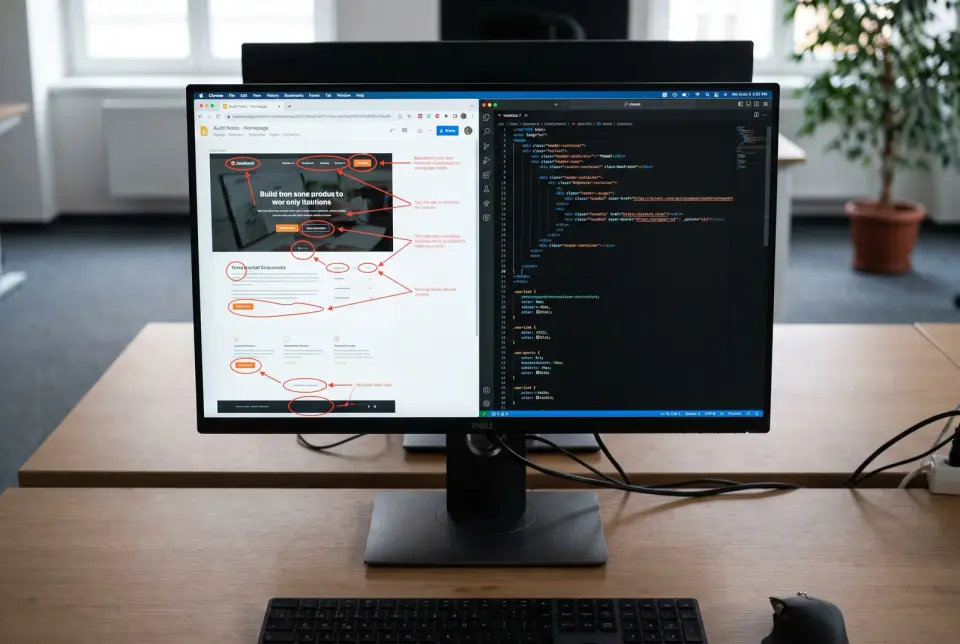
    How we workWe go through the product screen by screen against established usability heuristics, checking your analytics at the same time, so every finding is grounded in real behavior. We then rank the findings by severity and by how much work each fix takes. We finish with a call to walk through the report together, so it's clear where to start.

    What you getA document that lists the exact spots where the product slows people down. Each one gets a screenshot, a severity rating, the reason behind it and a fix your developer can act on directly. Items are sorted by impact and effort, so you can see what to tackle first and what can wait.

    What's included

    • Findings sorted by impact
    • A suggested fix for every problem
    • Backed by your own analytics
    • Clear to developers and owners alike
    • Useful even without more work

    User research

    We ask your users why they behave differently than you expect.

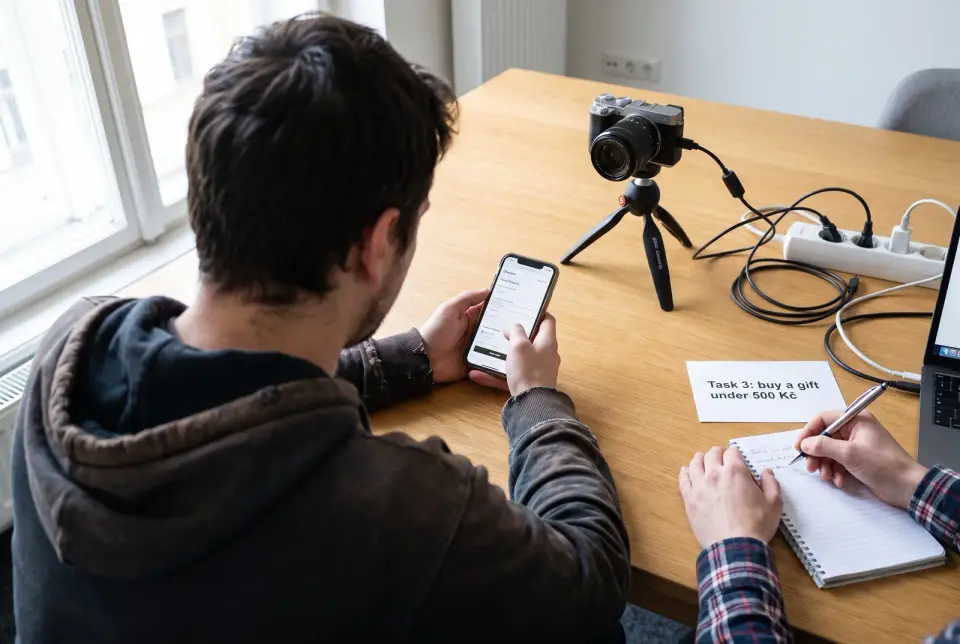
    In short We interview and watch real people use your product. Five conversations are usually enough to surface the main problems. We plan the sessions, run them and turn the results into findings your whole team will actually read.

    How we workWe define the question the research needs to answer, write the interview script and recruit participants who match your actual customers. We run the sessions with the product in hand and watch people work through real tasks. Sessions are recorded with participants' consent, and we tag findings as we go so every conclusion traces back to its source.

    What you getA short document with findings, quotes and recommendations, organized so it splits cleanly between design and development. It comes with clips from the recordings showing where people got stuck, plus the interview script, so you can repeat the research whenever you need to.

    What's included

    • Interviews with actual users
    • Backed by session recordings
    • Recommendations split for design and dev
    • A short document people really read
    • Based on real behavior

    Competitor Analysis

    How competitors handle the same moments and where people get lost.

    In short We take competitors apart side by side: onboarding, checkout, pricing pages, the same flows your product has. It shows what the market treats as standard, where everyone struggles and where you have room to win.

    How we workTogether, we pick the companies you actually compete for customers with, usually not the biggest names in the field. We walk through their sites using the same method as yours and check which search terms they show up for. All findings land in one table, so everything reads side by side.

    What you getA point-by-point comparison, covering the first screen, the enquiry process, pricing, content and search visibility, backed by screenshots. It flags what counts as industry standard, where the whole market falls short and where it's not worth competing at all.

    What's included

    • Same method for every competitor
    • Standard practice and open gaps
    • Searches where competitors show up
    • Recommendations you can use now

    What's in the box

    You do not order these separately: they are in every job, and they are ours to do.

    Information architecture

    We decide what goes where so visitors never stop to wonder “where do I click?”. Card sorting, navigation trees and labeling build the invisible structure that makes a big site feel simple.

    We find out how users would sort the content themselves: people group your pages and name those groups in their own words. From that we build the page tree and test the labels against what people actually type into search. We walk you through the structure using real, concrete content.

    OutputA page tree, a proposed menu and labels built from the words people actually use, plus a rule for where new content should go. On larger sites, you also get a redirect map from old URLs to new ones.

    • Navigation built the way users think
    • Labels drawn from real search terms
    • A rule for where new content goes
    • A redirect map for rebuilds

    Customer Journey

    We map every step from “never heard of you” to loyal customer, including the parts that happen off your website. It shows which touchpoint leaks the most customers and what to fix first.

    We start with what you already have (analytics, enquiries, support questions) and add interviews with people who actually went through the journey. We piece the steps together into one map and attach a number to each: how many people drop off right there.

    OutputA map of the journey from first contact to referral, noting what the person is dealing with and what stops them at every point. Every leak comes with a proposed fix and a rough scope for the work, and the map itself is built so you can keep updating it as leaks close.

    • Every step, on-site and off
    • Built from your data and interviews
    • Shows exactly where people drop off
    • A concrete fix for each leak

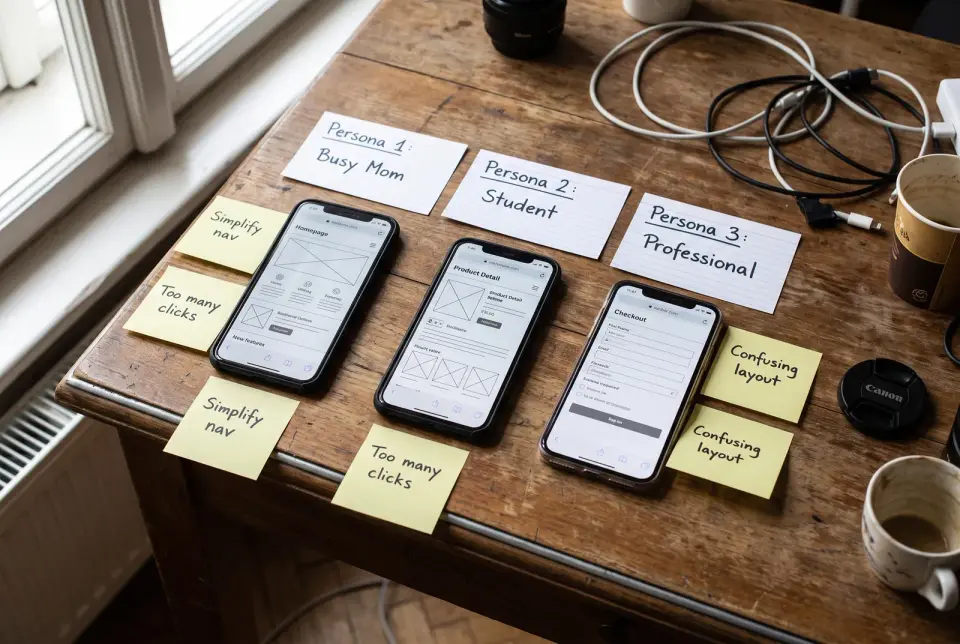
    Personas & Scenarios

    Compact, evidence-based profiles of your key user types and the situations they arrive in. A practical tool for settling design debates: “which user are we building this for?”

    We build them from what's already known: interviews, data and the enquiries you get. Each persona comes with two or three scenarios, concrete tasks the product has to handle. We review the draft with you and cut anything that wouldn't actually help you decide.

    OutputA set of short customer profiles and the situations they show up in, one page each, with scenarios and a note on what turns that person away. Your team can then use them to settle a design debate that's gone in circles.

    • Profiles grounded in real data
    • Concrete scenarios, real tasks
    • A tiebreaker for design disputes
    • One page, one persona

    Technologies

    Sound familiar?

    John Doefirst call
    1. We get traffic and almost no enquiries

    2. When people arrive and leave, the ads are rarely the problem. The audit finds where they drop off: an unclear offer, a hidden contact, a form with ten fields. Every finding comes with the cost of fixing it.

    3. Everyone on the team has a different opinion on the site

    4. Behaviour data settles the button-colour argument. We show recordings, heatmaps and test results, so decisions rest on facts and the loudest voice in the room loses its weight.

    5. Customers keep calling with questions the site already answers

    6. If the answer is on the site and nobody finds it, the structure is at fault. We build the information architecture around how people actually search and check it with a card-sorting test.

    7. We're planning a redesign and don't know what to keep

    8. A redesign without research often throws away what worked. We first measure which pages and paths earn money and carry them into the new design. Only what demonstrably slows people down gets rebuilt.

    Which one sounds like you?

    Pick your case and enter your own numbers. The screen works out what you're losing or gaining.

    People leave and I can't tell why

    Visitors a month2,000
    How many visitors buy1.5%
    Average order€120

    For a UI/UX audit to pay for itself in 3 months, you just need

    +8.3% on conversion

    Right now the site brings in about €3,600 a month: 2,000 visitors, of which 1.5% buy at €120. A UI/UX audit typically costs €900.

    Typical price from the studio price list. Revenue here ignores margin. This is the breakeven point, no one can guarantee a conversion increase in advance.

    I'm starting something new

    Development budget€20,000
    How many screens you think will need reworking25%

    At risk of rework after launch

    €5,000 of the budget

    Reworking 25% of the screens after launch means paying another €5,000 out of €20,000. A clickable prototype typically costs €1,200, and these changes happen there before any code is written.

    You set the share that needs reworking. The prototype's typical price comes from the studio price list.

    My product drifted

    How many people work on the interface4
    Hours a week each spends tweaking screens3 h
    How much your hour is worth€30

    Inconsistency costs you

    €1,559 a month

    4 people at 3 h a week each, at €30 an hour. A design system typically costs €2,650 and pays for itself in 1.7 months.

    You set the hours and the rate. This is an upper estimate: we assume the system removes the tweaking entirely. Typical price from the studio price list.

    Ask a few colleagues and call it done?

    A quick poll in the office or among friends says something and costs nothing. For some questions it's all you need. The difference is whether you ask people who know your product or people who are about to buy it for the first time.

    When your own research is enough

    • You want to check one small thing, like a button label or a service name
    • The site gets a few hundred visits a month and the data wouldn't show much
    • You have customers at hand and can ask them without leading
    • The decision is easy to undo if it turns out wrong

    When it gets expensive

    • Colleagues know the product by heart and simply don't see what confuses customers
    • Questions like “would you like…” measure politeness and reveal nothing about behaviour
    • Survey answers can't show where exactly people leave the site
    • You base a redesign worth thousands on the results and the mistake only shows after launch

    From the first call to a ranked list of fixes

    1. You know what we measure

      Call and goals

      Half an hour on what the site should do: enquiries, orders, sign-ups. We agree which pages and paths to cover and you get a fixed price.

    2. You see where people leave

      Data and analytics

      We go through Google Analytics, heatmaps and session recordings if you have them. If tracking is missing, we set it up so before and after can be compared.

    3. You have a list of snags

      Walkthrough as a customer

      We go through the site as three customers with different goals. Every place where someone searches, hesitates or leaves gets logged with a screenshot.

    4. You hear real people

      Interviews and tests

      For user research we run interviews and task-based tests with five to eight people from your audience. You get the recordings.

    5. You know what to fix first

      Ranked fixes

      Every finding gets an impact, an effort and a proposed fix. The list is ranked, so the top holds what earns the most for the least work.

    6. You decide calmly

      Walkthrough and next step

      A 20-minute video walkthrough and a call on the results. You can make the fixes yourself, with another team or with us. The document is yours.

    What a UX audit and research cost

    The price is fixed and you know it after the first call. UX audit from €500, user research from €800, information architecture from €600. Nothing is added on top, the price is final.

    Check pricing

    Evidence first, taste second

    Evidence drives our design decisions: research tells us what to fix, prototypes prove it works on real people, and analytics confirm whether it worked after launch. Everything sits on one design system, a single source of truth for color, type, spacing and components. A screen that used to take days now takes hours, and the product stays consistent as it grows. We don't vanish at handoff either: a designer stays on call through development, so the shipped product matches the one we tested.

    What you ask most often

    What is UX and how is it different from UI?

    UX (user experience) is how easily someone reaches their goal on your site: finds information, sends an enquiry, pays. UI (user interface) is how the screens, buttons and forms look. UX research finds why people leave, UI design then shapes what they see.

    What exactly do I get from a UX audit?

    A document with problems ranked by impact, each with a screenshot, an explanation and a proposed fix. Plus a 20-minute video walkthrough of your site. You can hand the result to anyone, it's yours.

    How much does a UX audit cost?

    A UI/UX audit from €500, typically around €900 depending on the number of pages and paths. User research with interviews from €800, competitor analysis from €500. You know the price upfront and it doesn't change. Nothing is added on top, the price is final.

    How long does an audit take?

    A UX audit takes five working days from the moment we have access to your analytics. Research with interviews takes two to three weeks, because finding and scheduling participants takes the most time.

    We don't get much traffic. Is an audit worth it?

    Below roughly a thousand visits a month the data says little. A customer walkthrough still works, but we'll usually suggest bringing people in through SEO or ads first and auditing once there's something to measure.

    How many people do you need for a test?

    According to Nielsen Norman Group, five participants surface about 85% of usability problems. More people mostly confirm what we already know. For different audiences we test five from each.

    Where do you find people for interviews?

    Ideally among your customers, because they know the problem you solve. When that isn't possible, we recruit participants by profile through panels and networks. Participant incentives are included in the price upfront.

    Will you make the fixes after the audit?

    If you want, yes. Design and development are one team, so nothing has to be explained twice. The audit doesn't depend on a follow-up project, though, and you can hand the results to your own team.

    Will you measure whether the fixes helped?

    Yes. Before the fixes we record the baseline, such as the share of sent forms or completed orders, and compare after release. Without before-and-after numbers, a redesign's success is guesswork.

    Ready to build something solid?

    Drop us a message. We reply within a few hours to set up a quick chat.

    1. 1Within hours: a human reply: first thoughts, maybe a question or two.
    2. 2Within days: a 30-minute call. You talk, we listen. Free, no obligations.
    3. 3After the call: a written fixed quote, or an honest answer that we're not the right fit, with a tip on who to ask instead.

    No sales scripts. You'll be talking to the people who'll actually build it.

    Allergic to forms? Fair.info@chronicles.cz+420 773 230 278

    By submitting this form, you're agreeing that we can use the details above to answer your enquiry. How we handle your data. We use it only to reply. We never sell it or add you to a mailing list.