Straw Panel Factory
A factory building eco-homes from straw panels needed a website that could explain a product most people have never heard of.
Measured on the live site, exactly as a visitor sees it.
Yanone Kaffeesatz
HeadingsAa
- Straw PanelMedium 500
- Straw PanelBold 700
АБВГҐДЕЄЖЗИІЇЙ abcdefghijklm 0123456789
Inter
Body textAa
- Straw PanelRegular 400
- Straw PanelBold 700
АБВГҐДЕЄЖЗИІЇЙ abcdefghijklm 0123456789
Lato
MenuAa
- Straw PanelBold 700
ABCDEFGHIJKLM abcdefghijklm 0123456789
Corner radii
- 20 px
- 24 px
- 30 px
Buttons: 30 px
Type scale
- AaH1, 72 px
- AaH2, 40 px
- AaH3, 36 px
- AaLead, 24 px
- AaBody, 20 px
Contrast
- 11.8 : 1text on background, AAA
- 11.8 : 1light text on dark, AAA
Shadows
A soft neutral shadow
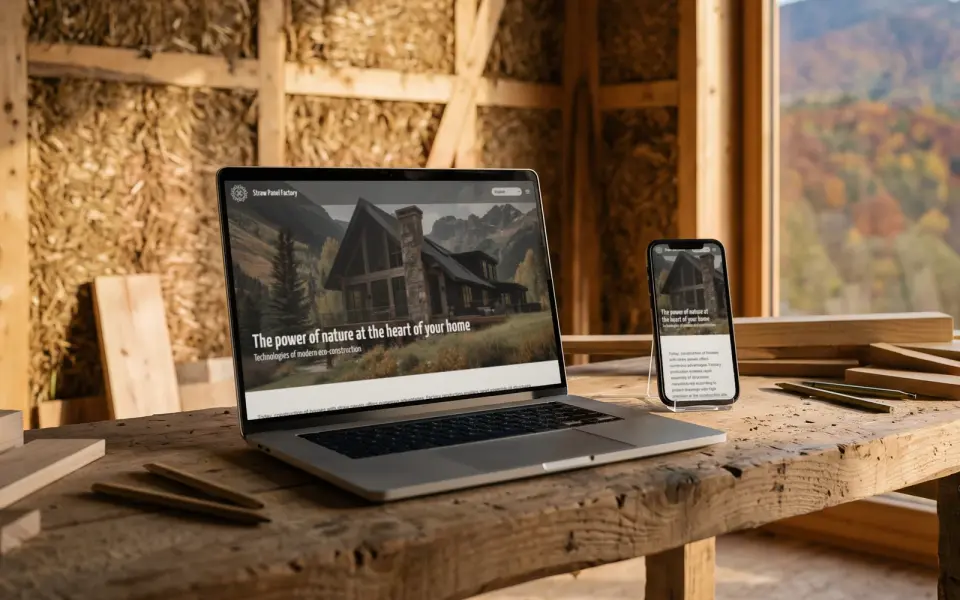
Context
The factory builds straw-panel houses near Kyiv and ships kits across Ukraine and for export to Europe. Panels are assembled at the plant to the project drawings: straw is pressed at 12 tonnes, the wood frame gets bio fire protection, and a finished wall panel weighs 40 kg per m² and holds a load of 12.5 tonnes. On site, the panels simply snap together into the house shell like construction-kit pieces.
The Challenge
Straw panel construction is serious technology. It reaches A+ energy class and passive-house standard. Heating stays under 15 kWh per square meter a year, sound reduction goes up to 56 dB, fire resistance hits REI 60, and the service life runs past a hundred years. Almost nobody searches for any of that, and first-time visitors show up skeptical: straw, in a house? The factory had no site at all. Sales ran on phone calls, and every call opened with twenty minutes of explaining the basics.
The constraint
The site has two different readers. The first is a future homeowner hearing about straw houses for the first time and looking for an answer to one question: is this even safe? The second comes for technical numbers: an export partner just needs the panel specs, no explanation from scratch. One set of copy had to work for both.
The decisions, pinned where they live
Why we made it this way.
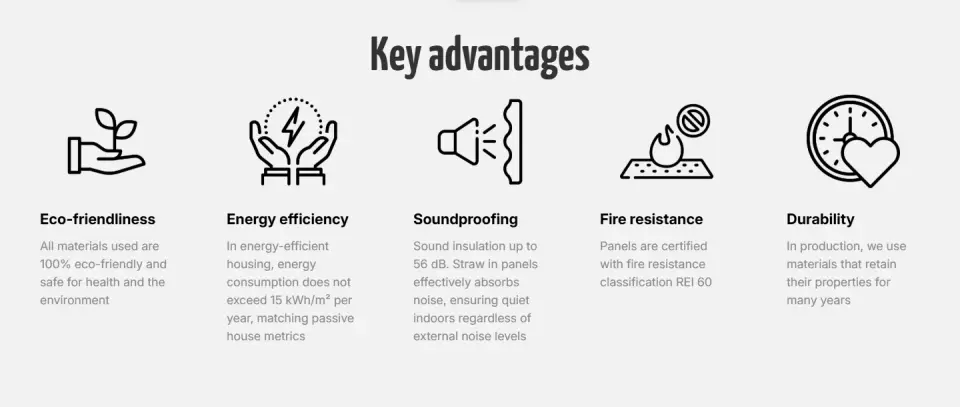
The panel is straw, wood and clay: natural materials with no toxic additives. The house needs no disposal process at the end of its service life.
Heating and cooling use no more than 15 kWh per m² a year, passive-house level, shown right in the benefits block.
The straw fill blocks outside noise better than mineral wool. The number sits right in the benefits block on the first screen.
Pressed straw doesn't get enough oxygen to burn. The clay coating holds around 1,000°C for a full hour.
The panel is straw, wood and clay: natural materials with no toxic additives. The house needs no disposal process at the end of its service life.
Heating and cooling use no more than 15 kWh per m² a year, passive-house level, shown right in the benefits block.
The straw fill blocks outside noise better than mineral wool. The number sits right in the benefits block on the first screen.
Pressed straw doesn't get enough oxygen to burn. The clay coating holds around 1,000°C for a full hour.
What we did, and why
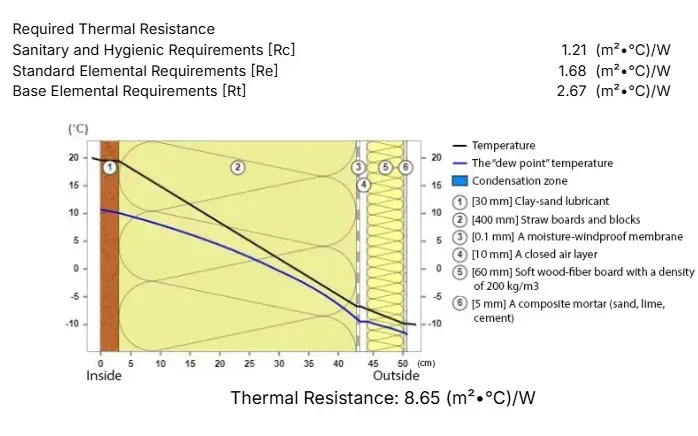
Documentation in English
We laid out and translated the technical documentation for partners abroad. One example is the thermal calculation of a wall for the Kyiv region: thermal resistance of 8.65 m²·°C/W against a base requirement of 2.67, with a temperature and dew point chart through every layer of the wall.
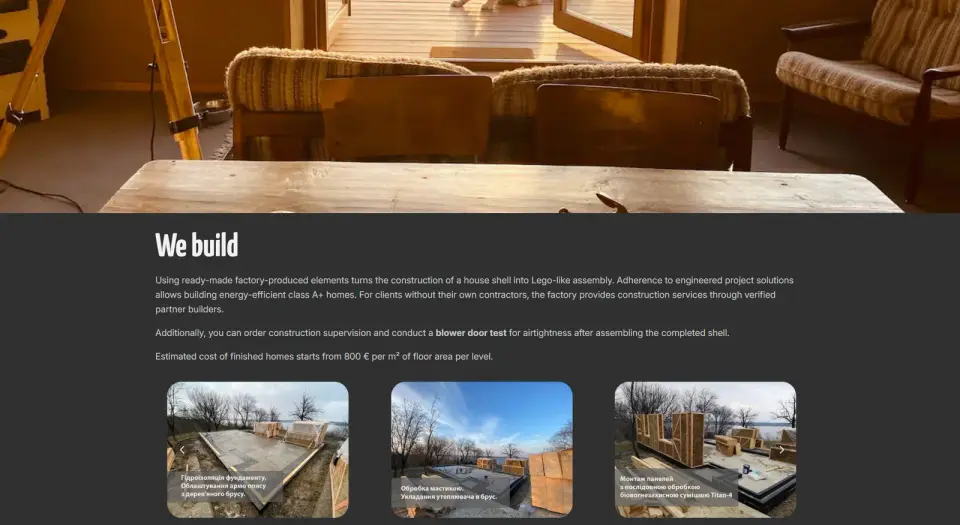
Real photos from the build site
A photo carousel from an actual build: foundation, ring beam, shell assembly. Each frame is captioned with the stage's name.
Pages for partner materials
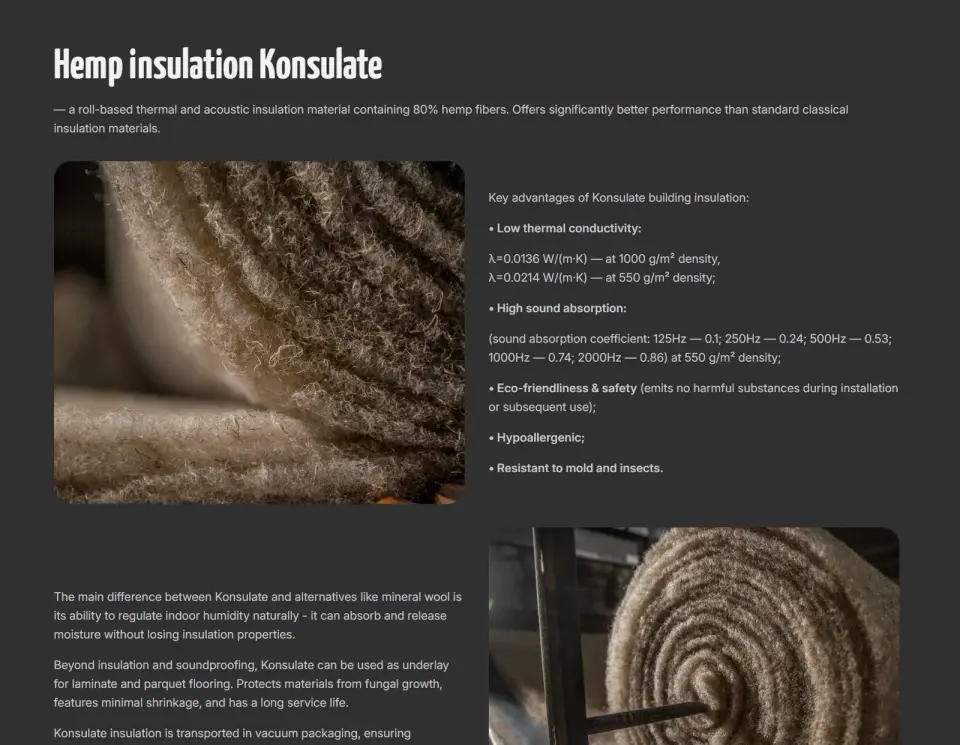
The materials the factory works with get pages of their own. Konsulate insulation: a roll with 80% hemp fibre, thermal conductivity of 0.0136 W/(m·K) at 1,000 g/m², sound absorption by frequency and how it differs from mineral wool. The same Konsulate™ is made by Fabrika Sumy, another of our cases.
A blog that answers the buyer's questions
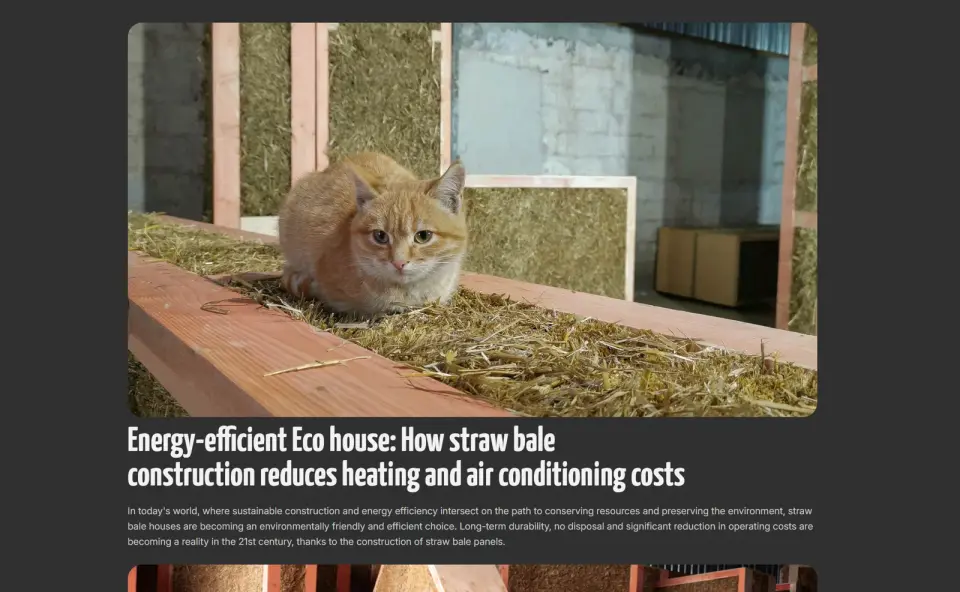
The articles cover what people come with: how much an energy-efficient house saves and how straw panels cut heating and cooling costs. Every article ends with a consultation form.
The SEO thinking behind it
Hreflang on both versions
Every page declares its uk-UA and en-US match through hreflang and x-default, so search engines never confuse the Ukrainian and English versions.
Organization in structured data
Every page carries JSON-LD Organization markup with address, social links and logo, plus separate WebSite markup. Search engines get the company card straight from the page code.
Canonical on every page
Every page has its own canonical address, so there are no near-duplicate URLs. The homepage has its own og image for social previews, and the rest share one.
HTML ready before JavaScript
The Nuxt server renders pages ahead of time, so a search bot gets finished HTML with the text right on the first request.
Where it landed
The site now handles the first twenty minutes of every sales call itself. Inquiries arrive already informed, and the export conversation starts with a link instead of a PDF.
A closer look
Click any frame to open it full screen.