

API Integration and Systems Architecture

When your systems don't talk to each other, you pay for it: retyped data, mistakes, decisions made on numbers that are already out of date. We connect them, e-shop to ERP, CRM to accounting, anything with an API to anything else, and build the web architecture that holds it all up. We start with whatever your team retypes by hand today, because that is where the work pays off first.

From€400per project

  • €0a month in licences, the code is yours
  • 100%of transfers written to a log
  • 1 processto start with, the one that hurts most
  • 1 dry runbefore the manual transfer is switched off

API integration connects your systems so they pass data to each other and nobody has to act as the middleman. Connecting to an existing service costs from €400, a custom API from €600, synchronising several systems from €800. Every connection has a log, error alerts and documentation.

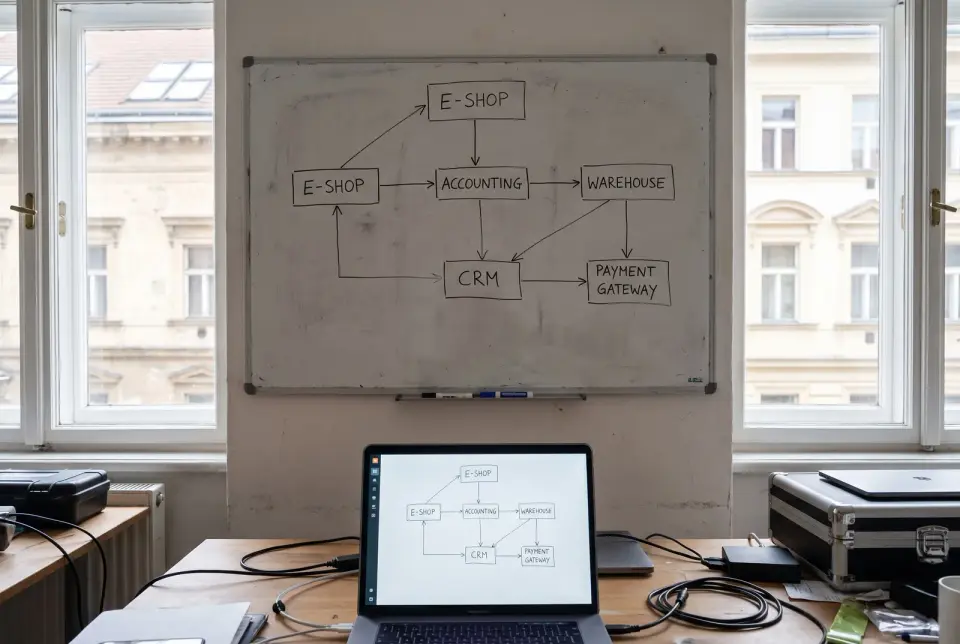
We connect shops, accounting, warehouses, CRMs and payment gateways, Czech and international.

We connect shops, accounting, warehouses, CRMs and payment gateways, Czech and international.

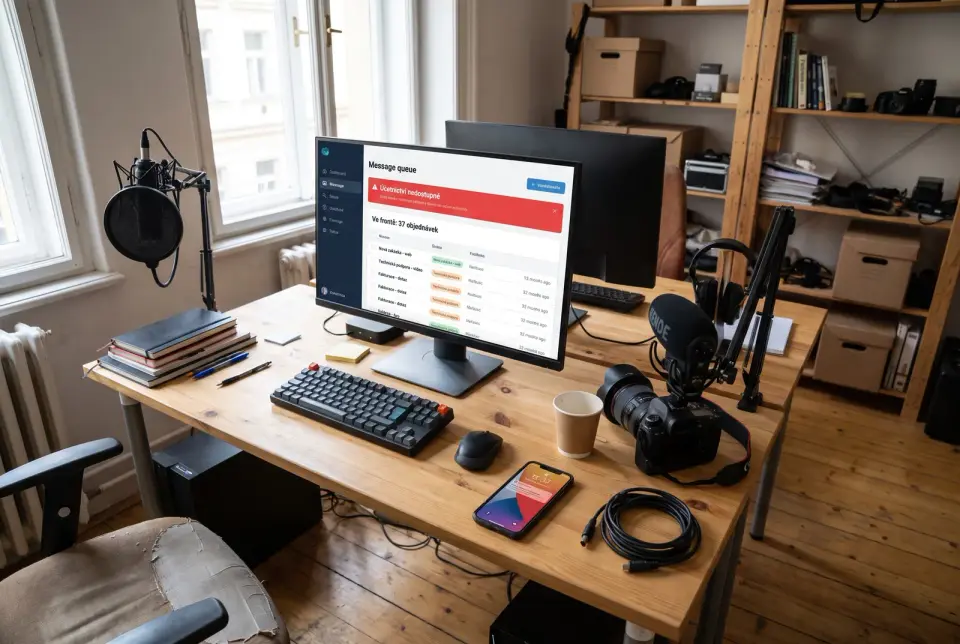
When a connection fails, an alert goes out and the data waits in a queue until it's fixed.

When a connection fails, an alert goes out and the data waits in a queue until it's fixed.

Every connection comes with documentation, so another developer can change it too.

Every connection comes with documentation, so another developer can change it too.

We choose the architecture by data volume and budget, with no technology for show.

We choose the architecture by data volume and budget, with no technology for show.

Every service in this category, explained

  • API Development

    Your own API for partners, apps and other systems.

    In short Proper REST or GraphQL APIs: documented, versioned and ready to grow, whether you’re opening your data to partners or need a clean layer over a messy legacy system. This is API software your partners can depend on, built and documented, never a rough prototype.

    How we workWe design each interface with versioning, clear error states and rate limits, so it can grow later without breaking whatever’s already built on it. Documentation gets written alongside the code as we go, never left for later. Where there’s a tangled legacy system underneath, we build a clean layer over it.

    What you getA working API with documentation, a test environment and access keys, plus traffic monitoring so you can see who’s using it and where it’s straining. A partner or a mobile app can then connect on its own, without emailing you for every detail. You get API software ready for production from day one.

    What's included

    • Clear error states, proper versioning
    • Docs written alongside the code
    • One clean layer over the old system
    • Includes traffic monitoring

    External integrations

    Connections to payments, carriers, accounting and ERP.

    In short Payment gateways, carriers, accounting, ERP, marketing tools. We wire in error handling and monitoring, so a broken integration fails loudly instead of quietly corrupting your data. It is the same API software approach behind every connection we wire in, built for your case, never a black box.

    How we workBefore we write a line of code, we check whether a reliable ready-made integration already exists, since custom code costs you something every month it keeps running. When we do build one, it fails loudly: retries, alerts, logging. We also test what happens when the other side goes down, so no order gets stuck halfway through.

    What you getA working connection to your payment gateway, carrier, accounting, ERP, marketing tool or booking system, running with alerts if it errors out. Each one comes with a map of what gets sent where and how often, handy later when something needs to change.

    What's included

    • Alerts and retries on failure
    • Covers the other side going down
    • A map showing what goes where
    • We’ll flag a ready-made option first

    PWA Development

    A web app on the home screen, with no app store needed.

    In short Web apps that install like native ones: offline mode, push notifications, an icon on the home screen, no app-store approval to wait for and no second codebase to maintain.

    How we workWe start by being upfront about where this approach hits its limits, since some phone features stay out of reach either way. Then we build the app to work on a weak signal, handle notifications and launch from a home-screen icon. We test install and update behavior on real phones.

    What you getAn app people add straight to their home screen, no app-store download needed, with notifications, offline mode and updates that happen automatically. The plain browser address keeps working too, so anyone who’d rather skip installing can just use that.

    What's included

    • Installs from an icon, no store
    • Keeps working on weak signal
    • One codebase, no second app
    • We’re upfront about where it falls short

    Headless Solutions

    A new site design without touching stock and orders.

    In short Content and commerce logic split from the front end. You can redesign the site without anyone touching stock, orders or the editorial workflow, and one content system feeds the site, the app and the screen in the shop. For a small site it does not pay off, because running it takes more work.

    How we workWe start by telling you honestly when a ready-made platform is enough and when going headless actually pays off. If we do go headless, we split content and business logic away from the front end and pre-build pages to serve from a fast network. The admin panel stays hidden from the open internet.

    What you getA separated content system that feeds your website, app and in-store screen, so a copy change happens once and shows up everywhere. The front end can then be redesigned freely, without touching your warehouse, orders or editorial workflow.

    What's included

    • Change the look, leave commerce alone
    • One content hub for web, app, store
    • Faster pages, smaller attack surface
    • We’ll say honestly if it won’t pay off

    Cloud Solutions

    Hosting sized to real traffic, with no downtime.

    In short Hosting, serverless, CDN and CI/CD sized to the traffic you actually get, with costs you can predict and deploys that skip the maintenance window.

    How we workWe pick hosting and services based on your actual load and budget, set up backups and, most importantly, actually test restoring from them. Deployment runs automatically from your repository, with a rollback ready for when something goes wrong. Monitoring and alerts go live before the site does.

    What you getA running setup on your own accounts, with a tested backup restore, automatic deployment from your repository and alerts if something goes down. You also get a written architecture overview and a cost estimate based on the load you’re actually planning for.

    What's included

    • Backups we’ve actually tested
    • Deploys with zero downtime, easy rollback
    • Alerts land before customers notice
    • Accounts and access, always yours

    What's in the box

    You do not order these separately: they are in every job, and they are ours to do.

    Custom connectors

    When no ready-made connector exists for your pair of systems, we write one. That is the usual case with older accounting and warehouse software, where the API is half-finished or missing. System integration here is worth solving individually, outside universal tools.

    Before we start building, we check what each side can actually give us. Then we agree the sync frequency, what wins in a conflict and what happens to a record that fails validation. The connector runs a dry pass first, so we can compare both sides before switching off the manual transfer for good.

    OutputA custom connector between your two systems: logged, documented and fully yours, so there’s no monthly fee going to a middleman you can’t control. You also get a transfer log for tracing a specific record and a written set of conflict rules.

    • Even when there’s no public API
    • Yours to keep, no monthly fee
    • Clear rules for conflicts and errors
    • We check it’s feasible first

    Webhook integrations

    Connections that react the moment something happens, in seconds, no more overnight batch jobs: order placed, invoice issued, warehouse notified, while the customer is still on the thank-you page.

    We set up both sending and receiving events, with signed messages and retries for when the first attempt fails. Every incoming message gets archived, so any of them can be replayed if something breaks later. If the other side can’t do webhooks at all, we cover it with scheduled polling.

    OutputA connection that reacts immediately, an event archive you can replay from, and a report on which messages failed and why. Your data stays current throughout the day.

    • Fires within seconds
    • Signed messages, automatic retries
    • Replayable, archived events
    • Works even without webhooks

    System sync

    One source of truth across e-shop, warehouse, CRM and accounting, with conflict rules set on purpose, never left to whichever system happened to save last.

    First we decide which system is the source of truth for each field. Then we set the direction and frequency of transfers, how conflicts get handled and what happens during an outage. Historical data gets migrated first, onto a copy, so any pairing errors show up before we switch to live.

    OutputSynchronization across your store, warehouse, CRM and accounting, with a written rule for where each field comes from. You also get a regular check that compares both sides and flags any difference, so a quiet sync failure shows up long before your next stock count.

    • Each field has one owner
    • Clear rules for conflicts, outages
    • Regular checks catch drift
    • Rehearsed first, then switched live

    Technologies

    Sound familiar?

    John Doefirst call
    1. Stock in the shop doesn't match reality

    2. Customers order goods that are already out of stock because levels are updated by hand or once a day. Warehouse-to-shop sync sends changes the moment they happen.

    3. We have five systems and each says something different

    4. A customer has one name in the CRM, another in accounting and a third in the shop. We decide which system is the source of truth for which data, and the rest align to it.

    5. Connections stop working now and then and nobody notices

    6. Silent failures cost the most: orders don't reach accounting for a week and it comes out at month-end close. Every connection we build is monitored and reports errors.

    7. Our old system can't connect to anything new

    8. When a system has no API, we build a middle layer that reads the export or database and offers the data through a modern interface. The old system can live out its days in peace until replacing it pays off.

    Which one sounds like you?

    Pick your case and enter your own numbers. The screen works out what you're losing or gaining.

    I repeat the same task every day

    Minutes a day on the same task30 min
    How many people do this2
    How much your hour is worth€30

    The routine eats up

    22 hours a month

    30 min a day for 2 people over 22 working days is €660 a month at €30 an hour. Automation typically costs €1,200 and pays for itself in 1.8 months.

    22 working days in a month. Upper estimate: we assume automation takes over the task entirely. Typical price from the studio price list.

    My tools won’t talk to each other

    Records a week you move by hand between systems61
    Minutes per record3 min
    How much your hour is worth€30

    Manual data entry costs

    €396 a month

    61 records a week at 3 min each is 13.2 h a month at €30 an hour. An integration typically costs €1,150 and pays for itself in 2.9 months.

    We count a month as 4.33 weeks. We don't count mistakes made during entry, their cost comes on top. Typical price from the studio price list.

    I have another quote for an integration

    What you were quoted€1,200
    For what

    The difference from our typical price

    €50

    You were quoted €1,200 for a service integration. With us that typically costs €1,150, from €400.

    Comparison against the studio price list. Number of systems and data scope vary, check against the actual quote.

    A ready connector from the marketplace?

    Common system pairs have ready-made add-ons, such as shop and accounting. When one fits your process, it's cheaper than development. The difference shows with exceptions, volume and the day the connector stops working.

    When an add-on is enough

    • You're connecting two common systems and an add-on handles it
    • Your process has no exceptions the add-on doesn't know
    • Data volume is small and a few minutes' delay doesn't matter
    • The add-on vendor offers support you can rely on

    When you need a custom integration

    • Data flows through three or more systems, each with its own rules
    • The add-on can't handle your exceptions and people fill them in by hand
    • An outage costs orders and you need to know about it at once
    • The system has no ready connector or no API at all

    From isolated systems to data that flows on its own

    1. You see how it all connects

      Call and systems map

      We sketch which systems you have, what data flows between them and where a person retypes it today.

    2. It's clear which system is right

      Source of truth

      For each data type we pick the system that decides: customers, prices, stock, orders. You get a fixed price.

    3. The architecture is on paper

      Design

      We choose the route: API, webhooks, scheduled sync or a middle layer. We describe what happens when either side goes down.

    4. The connection runs

      Development

      We build the integration, first on test data, then alongside live operations. We compare results before you rely on it.

    5. You hear about outages at once

      Monitoring

      A log of every exchange, a queue for failed records and alerts when something breaks. Nothing disappears silently.

    6. Someone else can change it

      Documentation

      A description of every connection, data field and error state. Maintenance can stay with us or go to your own developer.

    What integration costs

    Third-party integrations and webhooks from €400, custom API from €600, custom connector from €750, system sync from €800. PWA from €1,200, cloud solutions from €1,450, headless from €1,850. Nothing is added on top, the price is final.

    Check pricing

    AI built to actually do the work

    AI and automation earn their keep when they’re wired into real workflows with real data. Without that, it’s just theater. We build the first kind: we map how the work actually happens, put a price on the wasted hours, and automate the steps where the numbers make the case on their own. Tools run on infrastructure your team can maintain, monitored so failures get flagged immediately, and handed over with full documentation and access. You end up owning the code and the pipeline. There’s no black-box subscription you can’t see inside.

    What you ask most often

    What is an API?

    An API (application programming interface) is an agreed way for two programs to exchange data without a person. A shop asks the warehouse through the API how many items are left, and the warehouse answers. Most modern systems have an API.

    What is system integration?

    System integration connects a company's software so it passes data on its own: shop, accounting, warehouse, CRM, payment gateway. The result is one source of truth and an end to manual retyping.

    How much does an API integration cost?

    Connecting to an existing service from €400, typically around €1,150, a custom API from €600, multi-system sync from €800. The price depends on the number of systems, exceptions and data volume. Nothing is added on top, the price is final.

    REST API vs GraphQL?

    REST is simpler and almost every system supports it. GraphQL pays off when an app needs to assemble lots of different data from one place at once. We mostly build REST and recommend GraphQL where it saves work.

    What if a system has no API?

    Data can come from a regular export, straight from the database or through a middle layer we build. Such a connection is more fragile, so we monitor it more closely.

    What are webhooks?

    A webhook is a message a system sends on its own the moment something happens, such as a paid order. Compared with polling on a schedule, the change arrives immediately and doesn't load the server needlessly.

    What are headless and PWA?

    Headless separates content and data from presentation, so one system serves the website, app and till. A PWA is a website that behaves like an app: it installs on a phone and works on a weak signal.

    What happens during an outage?

    Records that didn't go through wait in a queue and are sent once the other side is back. An error triggers an alert by email or chat. No data is lost.

    How long does an integration take?

    Connecting to an existing service takes one to two weeks, multi-system sync three to six weeks, including a parallel test with live operations.

    Ready to build something solid?

    Drop us a message. We reply within a few hours to set up a quick chat.

    1. 1Within hours: a human reply: first thoughts, maybe a question or two.
    2. 2Within days: a 30-minute call. You talk, we listen. Free, no obligations.
    3. 3After the call: a written fixed quote, or an honest answer that we're not the right fit, with a tip on who to ask instead.

    No sales scripts. You'll be talking to the people who'll actually build it.

    Allergic to forms? Fair.info@chronicles.cz+420 773 230 278

    By submitting this form, you're agreeing that we can use the details above to answer your enquiry. How we handle your data. We use it only to reply. We never sell it or add you to a mailing list.